
Buying Hunting Land Near Jacksboro, Texas: What Investors Need to Know
Before buying hunting land near Jacksboro, you need to verify mineral rights ownership, confirm the agricultural appraisal status to avoid rollback taxes, assess water access, and walk the terrain to evaluate wildlife habitat quality.
Why Jacksboro Hunting Land Deserves Your Attention Right Now
If you have been watching the rural land market across North Central Texas, you already know that Jack County sits in a sweet spot. Jacksboro is roughly seventy miles northwest of Fort Worth, close enough for a weekend drive from the DFW metroplex yet rural enough to support the kind of large, undeveloped tracts serious hunters want.
I have spent 17 years helping buyers navigate properties across Parker County, Palo Pinto, Wise, Hood, Tarrant, and Jack counties. What I consistently see is DFW-adjacent investors looking for recreational land within a two-hour drive, and Jacksboro checks that box perfectly. The terrain here, where the rolling Cross Timbers give way to open rangeland, creates quality white-tailed deer and feral hog habitat in North Central Texas. But buying hunting land is not like buying a house in Weatherford. There are due-diligence steps that can save you tens of thousands of dollars, and missing just one of them can turn a great investment into an expensive headache.
Understanding the Jacksboro Terrain and Why It Matters for Hunting
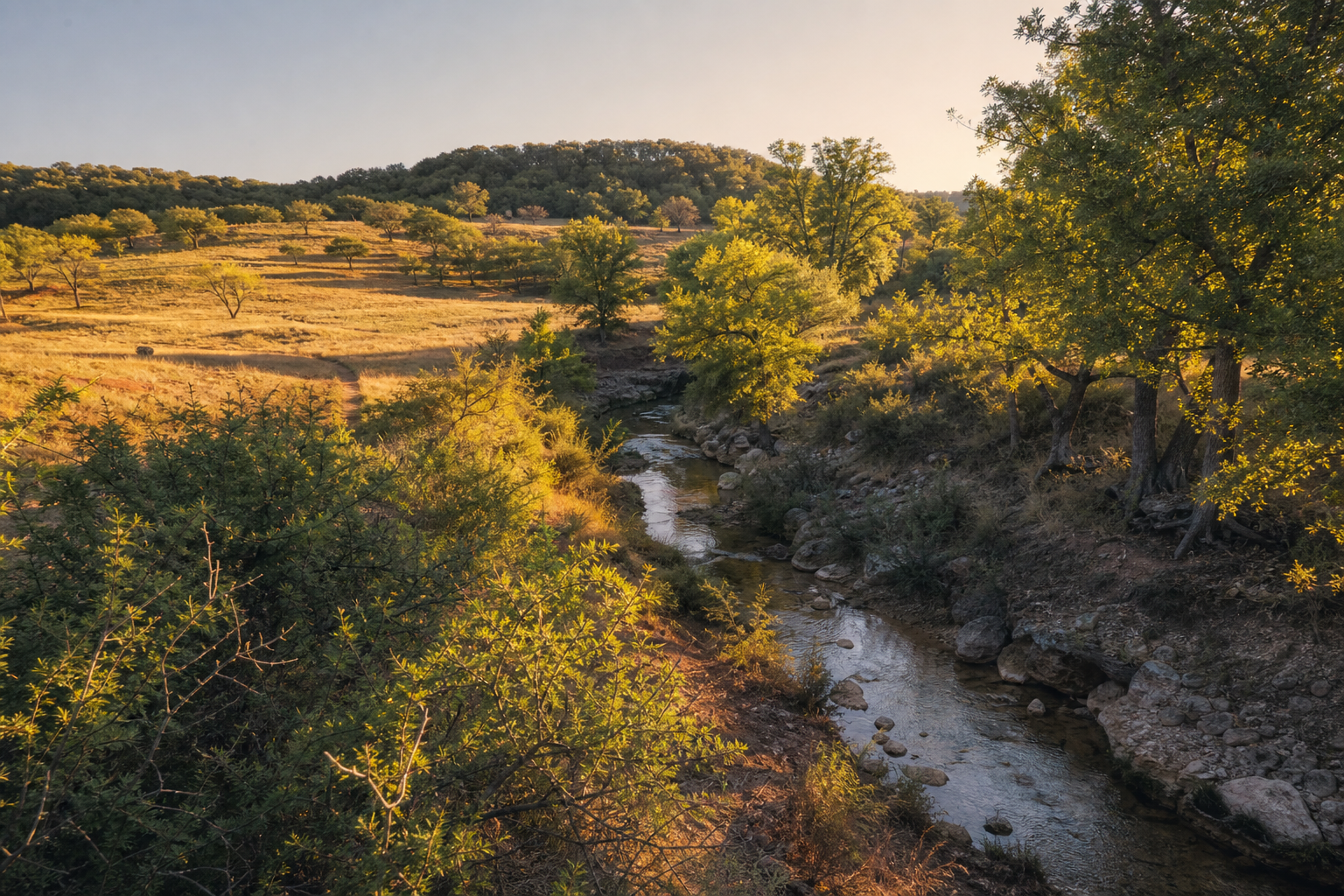
You cannot evaluate a hunting property from a listing photo. The land around Jacksboro is undulating to hilly, with light-colored loamy soils over reddish clayey subsoils, shale, and sandstone, according to Jack County historical records. The county is forested mainly by mesquite, live oak, blackjack oak, and post oak, with pecan, elm, walnut, and cottonwood running along the waterways.
What does that actually mean for your hunting investment? That mix of brush, hardwood mast, and creek-bottom cover is exactly what creates quality white-tailed deer habitat. The oaks produce mast (acorns) that draw deer in fall and winter, while the mesquite and brush offer bedding cover year-round.
What to Look for When You Walk a Jacksboro Tract
Before you make an offer on any Jack County property, walk it. Here is what I tell my clients to look for:
- Browse lines on trees and brush. If deer are over-browsing, the carrying capacity may already be maxed out.
- Existing game trails and rubs. Fresh sign tells you the wildlife is actually using the property, not just the neighbor’s land.
- Water sources. Stock tanks, creeks, and seasonal drainages dictate where animals concentrate. Without reliable water, you are managing land at a disadvantage.
- Topography variety. The best hunting tracts near Jacksboro have a mix of creek bottoms, ridgelines, and open meadows, giving you options for stand placement and different species.
The growing season in Jack County historically runs around 218 days, per Jack County records, which supports year-round forage. Average annual rainfall is historically around 30 inches per year, enough for good native grass production but not so much that the land becomes unmanageable.
Water Rights and Creek Access on Jacksboro Hunting Land
Here is something that surprises many first-time rural land buyers: in Texas, water rights and surface land ownership are two separate things. You can buy a gorgeous tract along a creek near Jacksboro and discover that you do not actually own the water running through it.
The West Fork of the Trinity River cuts diagonally across Jack County from northwest to southeast and serves as the main drainage system. Beyond the river, the county is laced with creeks, including East Rock, Howard, Lost, Crooked, the North Fork of Crooked, Little Cleveland, the West Fork of Keechi, Two Bush, and Henderson.
Specific Water Due Diligence for Jack County
When you are evaluating a property, confirm the following before closing:
Surface water rights. Are they included in the deed, or have they been previously conveyed to a third party?
Stock-pond easements. If the property has a stock tank, does the seller own the dam and impoundment rights, or does a neighboring landowner hold an easement?
Riparian access. If a creek runs through or along the property boundary, what are your access rights? This is especially important on tracts near the West Fork of the Trinity.
Groundwater. Does the property have a well? What is the water table depth, and does the local groundwater conservation district impose any pumping restrictions?
Water is consistently the second question, after price, that I hear from investors evaluating hunting land. Getting this wrong is not a minor inconvenience. It can fundamentally change the property’s value and your ability to manage wildlife.
Mineral Rights in Jack County: The Surprise That Can Sink Your Deal
This is the conversation that stops more deals than any other, and it is the mistake I watch buyers make most often in rural Texas. Mineral resources in Jack County include petroleum, natural gas, and stone according to county records. Texas law allows mineral rights to be severed from surface rights, and once they are severed, the mineral owner’s rights can be significant.
If you buy a hunting tract near Jacksboro and the mineral rights have been severed, the mineral owner (or their lessee) generally has the right to access the surface to extract those minerals. That can mean roads, pipelines, pump jacks, and drilling pads, all of which can disrupt your hunting operation.
How to Protect Yourself
Order a full mineral title search before closing. Do not rely on the seller’s verbal representation.
Ask specifically whether any active oil and gas leases exist on the property. Active leases create binding obligations that survive the sale.
Negotiate mineral rights into the deal when possible. If the seller still holds the minerals, try to keep them with the surface. If they have already been severed, understand exactly what that means for your intended use.
Review any existing surface use agreements. These agreements govern what the mineral lessee can and cannot do on the surface.
Having closed over 300 transactions and specializing in ranches, farm land, and recreational land, I can tell you that mineral rights are among the most consequential issues in rural Jack County transactions. Do not skip this step.
Agricultural Appraisal and Wildlife Management Tax Strategy Near Jacksboro
The property tax picture on hunting land near Jacksboro revolves around one concept: agricultural (ag) appraisal. Under the Texas Constitution and Tax Code, qualifying agricultural land is appraised based on its capacity to produce agricultural products (its productivity value) rather than at full market value. This can reduce your annual property tax bill dramatically.
Here is where it gets especially relevant for hunting investors: land used to manage wildlife may also qualify for this special-use appraisal, provided the land was previously qualified open-space or timberland and is actively managed under a wildlife management plan.
The Five-Year Rule You Cannot Afford to Ignore
Per the Texas Comptroller and Texas Tax Code Section 23.521, the land must have been devoted principally to agricultural use or to the production of timber or forest products continuously for the preceding five years before it can qualify for wildlife management special appraisal. This is a buyer trap. If the seller has allowed the ag valuation to lapse, or if the land was recently subdivided, you may face a rollback tax assessment covering up to five prior years of the difference between market-value taxes and productivity-value taxes.
What I tell my clients is this: before you sign anything, request the current appraisal district records from the Jack County Appraisal District and confirm the ag-use status is active and uninterrupted. If there is any gap, you need to understand your rollback exposure before you can accurately model the investment.
Hunting Lease Income Is Taxable
One more distinction that matters: according to the Texas Comptroller, open or undeveloped areas and land used for hunting or fishing leases are not considered farms or ranches for sales tax purposes, even if the land carries an agricultural appraisal for property taxes. Hunting lease revenue is generally treated as taxable income — consult a tax advisor to confirm how income tax applies to your specific situation, as the ag appraisal addresses property tax treatment only. Build your financial model accordingly.
Access, Location, and the Practical Realities of Jacksboro Land Ownership
Location is not just about scenery. For hunting land that you plan to visit regularly or lease to others, road access can make or break the deal.
U.S. Highways 281 and 380, along with Texas State Highways 114 and 199, all intersect at Jacksboro. This makes the town a natural hub for reaching rural tracts in multiple directions. These communities can affect which road-maintenance district your property falls within, which matters for year-round access.
Factors to Evaluate
Paved vs. unpaved road frontage. Highway frontage commands a premium but also means more traffic and noise. Interior tracts accessed by county roads are quieter but may be impassable in heavy rain without a 4WD.
Proximity to Fort Richardson State Park. The park sits in the southern part of Jacksboro and draws visitors year-round. Properties nearby benefit from established infrastructure, but you also want enough distance to maintain a quality hunting environment.
Neighbor land use. A hunting tract bordered by other managed hunting land or large ranches is far more valuable than one bordered by subdivisions or commercial operations.
Rated 5 out of 5 stars by past clients, I work hard to help buyers think through these practical details before they fall in love with a view. As one of my clients put it: “Her local knowledge of available properties is invaluable. She is a true professional in every sense.”
Frequently Asked Questions About Buying Hunting Land Near Jacksboro
What types of wildlife can you hunt on land near Jacksboro, Texas?
The terrain in Jack County supports white-tailed deer and feral hog as the primary game species. The mix of mesquite, live oak, blackjack oak, and post oak, combined with creek-bottom hardwoods, creates excellent habitat. Turkey, dove, and small game are also present depending on the specific tract and its habitat diversity.
How far is Jacksboro from Fort Worth and the DFW metroplex?
Jacksboro is roughly seventy miles northwest of Fort Worth, typically a drive of roughly an hour or more via US-281, depending on traffic and route. At roughly seventy miles from Fort Worth, it is within reach for DFW-based investors who want a weekend property without a long drive.
What is an agricultural appraisal and why does it matter for hunting land?
An agricultural appraisal means the property is taxed based on its productivity value rather than its full market value. For hunting land buyers near Jacksboro, this can significantly reduce annual property taxes. Land managed for wildlife may qualify, but it must previously have qualified as open-space land or timberland and must have been in continuous qualifying agricultural use for at least five years prior, per Texas Tax Code Section 23.521.
What are rollback taxes and how can they affect my purchase?
Rollback taxes are assessed when land loses its agricultural appraisal. The tax authority can recapture up to five years of the difference between the productivity-value taxes that were paid and the higher market-value taxes that would have been owed — an assessment that can attach to the land and become your liability as the new owner. If you buy a Jacksboro tract where the ag status has lapsed, you could face a rollback tax assessment on the property.
Do mineral rights come with hunting land in Jack County?
Not necessarily. Texas allows mineral rights to be severed from surface rights, and Jack County has petroleum, natural gas, and stone resources according to county records. You must order a mineral title search before closing to determine whether any mineral interest conveys with the sale or has already been severed.
Can I earn income from hunting leases on Jacksboro land?
Yes, but that income is taxable. The Texas Comptroller clarifies that land used for hunting leases is not considered a farm or ranch for sales tax purposes, even if it carries an ag appraisal for property taxes. Model your investment returns net of applicable taxes — consult a tax advisor on how lease income is treated — and net of any wildlife management plan expenses.
What water features should I look for on a hunting tract?
Reliable water sources are essential for wildlife management. In Jack County, look for stock tanks, spring-fed creeks, or proximity to the West Fork of the Trinity River and its tributaries. Verify in the deed whether surface water rights and any stock-pond easements transfer with the land, as water rights are separate from surface ownership in Texas.
Is Lake Jacksboro or Lake Bridgeport near available hunting tracts?
Both lakes are within Jack County and provide public water access points that often sit near rural hunting tracts. Properties near these lakes may offer dual recreational value, but waterfront parcels can carry different zoning and environmental considerations you should investigate.
What should I check about road access before buying?
Confirm whether the property has frontage on a paved county road or state highway, or if access is via a private or unpaved road. Interior tracts in the communities outside Jacksboro, such as those near Perrin, Cundiff, or Antelope, may require easement verification. Ask which road-maintenance district serves the property.
Do I need to file a wildlife management plan to maintain the tax appraisal?
If you convert an agricultural appraisal to wildlife management use, a wildlife management plan is generally required — an estate attorney or wildlife management consultant can confirm the specific filing requirements that apply to your property. The specifics of what the plan must include and how it is monitored can vary. An experienced local agent or a wildlife management consultant can help you navigate the requirements for Jack County.
The Bottom Line on Buying Hunting Land Near Jacksboro
Jacksboro and the surrounding Jack County landscape offer some of the most accessible and habitat-rich hunting land within reach of the DFW metroplex. But the investment only works when you do your due diligence: mineral rights verification, ag appraisal continuity, water rights confirmation, and honest terrain assessment.
With 17 years in the real estate business and a specialization in ranches, farm land, and recreational land across Parker County, Palo Pinto, Wise, Hood, Tarrant, and Jack counties, I understand the details that make or break a rural land purchase. I live on a ranch, raise cattle, and know this landscape firsthand. If you are serious about buying hunting land near Jacksboro, I would love to walk through the process with you. Call me, Lynae Amason, at 817-522-2897 or reach out through my office at 220 Fort Worth Hwy, Suite 700 in Weatherford. Let’s find the right piece of land for your goals.