
Thurber, TX Ghost Town: History and What’s Left to See Near Gordon, Mingus, and Strawn
What is the history of Thurber, TX, and what can you still see at this ghost town between Mingus and Strawn?
Thurber was once Texas’s largest company town with up to 10,000 residents, built on coal mining and brick manufacturing. Today, you can visit the iconic 126-foot smokestack, restored St. Barbara’s Church, a coal miner’s house, and the W.K. Gordon Center for Industrial History.
Why Thurber’s Story Matters Right Now for the Gordon, Mingus, and Strawn Corridor
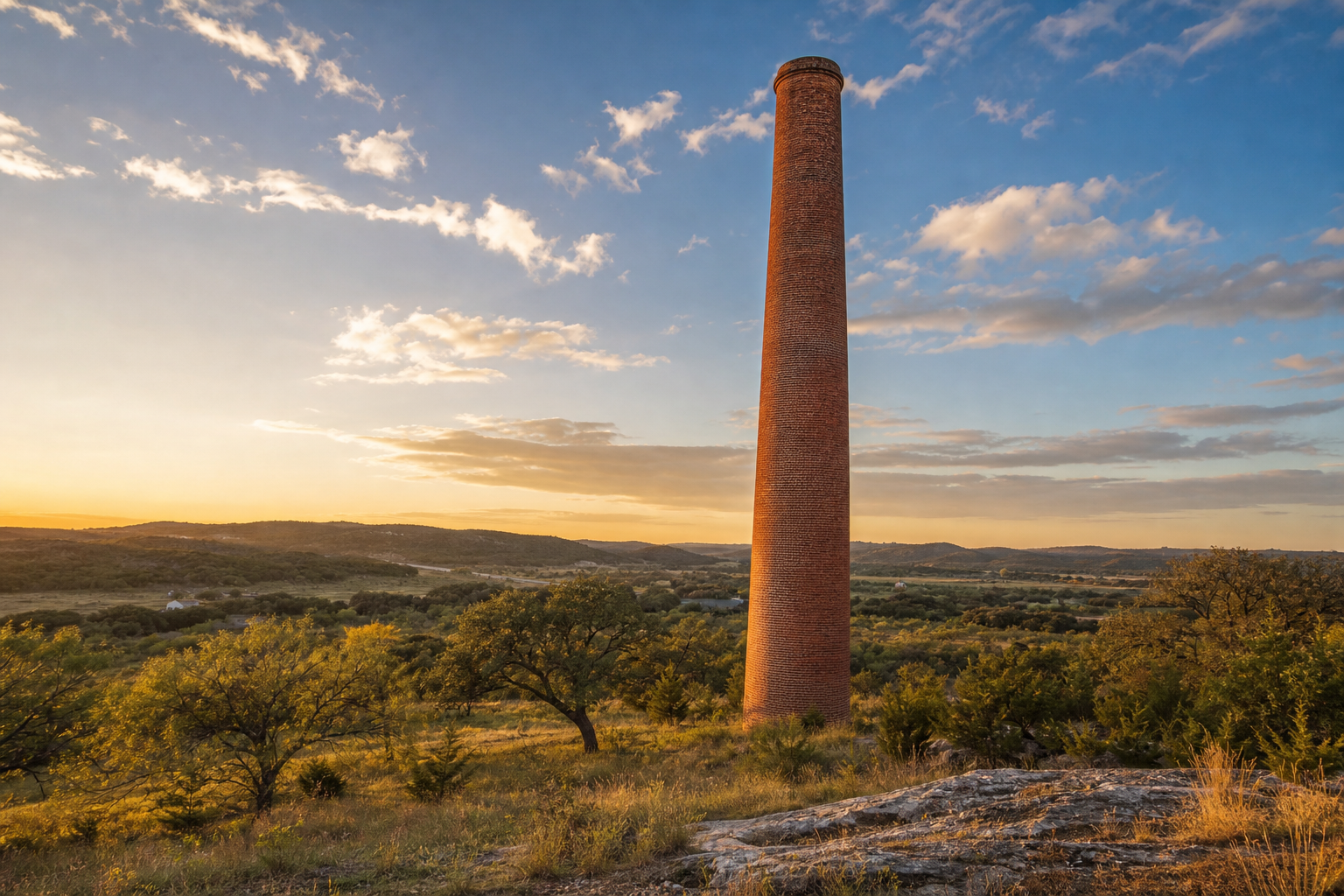
If you’ve ever driven I-20 between Fort Worth and Abilene, you’ve likely spotted that towering brick smokestack rising from the plains near Mingus. That smokestack is the most visible reminder of Thurber, a town that once rivaled small cities in population and industrial output, and it sits right at the heart of the Gordon, Mingus, and Strawn corridor that I know so well.
With 17 years of real estate experience across Parker County, Palo Pinto County, and the surrounding areas, I’ve watched interest in this stretch of I-20 grow steadily. Heritage tourism, rural land availability, and the roughly 75-mile drive from Fort Worth make the corridor increasingly attractive to investors, agritourism developers, and weekend-retreat buyers. Understanding Thurber’s past isn’t just a history lesson. It’s context for understanding what makes this part of Texas special, and why the land around it holds real potential.
The Rise of Thurber: From Coal Mines to Company Town
You might be surprised to learn that this quiet stretch of highway between Mingus and Strawn was once home to one of the most important industrial operations in the state. According to the Texas State Historical Association, coal-mining operations began at Thurber in 1886 when brothers William and Harvey Johnson sank the first shaft to supply bituminous coal to the Texas and Pacific Railroad during its westward expansion.
After the Johnsons struggled to meet payroll, the Texas and Pacific Coal Company took over in 1888 and built what became a fully enclosed company town. The company’s namesake, New York investor H.K. Thurber, helped finance the transformation. At its peak between 1918 and 1920, Thurber held a population of 8,000 to 10,000 residents from more than a dozen nationalities, with Italian, Polish, and Mexican communities predominating, per the Texas State Historical Association.
What Made Thurber Unique as a Company Town
Every detail of daily life ran through the company. Residents lived in company houses, shopped at company stores, and worshipped in company-owned churches. The Texas and Pacific Coal Company built a 200-room hotel, an opera house that seated 650, and the only public library in the county, according to Tarleton State University’s Gordon Center records. What I find fascinating about this, and what I tell investors who ask about the area, is that this level of infrastructure existed in a place most Texans drive past today without a second thought.
Here’s a piece of history that surprises almost everyone: in September 1903, more than 1,600 miners joined the Thurber local of the United Mine Workers, and on September 27, 1903, the company reached a labor agreement that made Thurber the first 100 percent closed-shop city in the entire nation, per the Texas State Historical Association. That’s a nationally significant labor milestone, right here in the corridor between Gordon and Strawn.
The Famous Thurber Bricks and Their Legacy Across Texas
Have you ever walked on a Thurber brick without knowing it? You probably have if you’ve spent any time in Fort Worth, Austin, or Galveston.
In 1897, the company established a brickworks using clay from the surrounding hills, specifically from what locals still call Steamshovel Mountain, a visible landmark near the site. Those signature red Thurber bricks paved streets and built structures across the state, including the Galveston Seawall, portions of the Fort Worth Stockyards, and Congress Avenue in Austin, per the Texas State Historical Association. Coal production peaked at 3,000 tons per day in 1919.
For you as a potential investor in the area, this brick legacy matters beyond the history books. The Thurber name carries real brand recognition across Texas, and that recognition is an asset for anyone looking at heritage tourism, hospitality ventures, or agritourism developments along this I-20 corridor between Gordon, Mingus, and Strawn. Living on a ranch myself in this part of Texas, I see firsthand how that kind of name recognition draws visitors to our communities.
How Thurber Became a Ghost Town Near Mingus and Strawn
So what happened to a town of 10,000 people? The short answer is oil replaced coal.
W.K. Gordon’s discovery of the Ranger oilfield in 1917 accelerated the railroad industry’s shift away from coal. The company renamed itself Texas Pacific Coal and Oil Company in April 1918, per the Texas State Historical Association. The writing was on the wall.
The Decline Timeline
- 1917: The Ranger oilfield discovery begins shifting energy economics away from coal
- 1918: The company formally pivots to oil, changing its name
- 1926-1927: Declining coal demand triggers wage cuts, labor unrest, and a major strike that drives many miners to other states
- By 1940: Thurber is effectively a ghost town
What’s important for you to understand, especially if you’re considering land purchases in the Gordon, Mingus, or Strawn area, is that this decline happened relatively quickly. Within about two decades, an entire city essentially disappeared. The Johnson family, who started it all, had also opened mines at both Lyra and Strawn, so the shared industrial heritage runs through the entire corridor.
What You Can Still See at Thurber Today
Now let’s get to the part most visitors want to know. If you drive out to Thurber off I-20, roughly 3 miles west of Mingus and 5 miles east of Strawn, here’s what you’ll find:
The Smokestack and Major Landmarks
The 126.1-foot brick smokestack from the original power plant is the dominant landmark, visible from I-20 and unmistakable against the rolling terrain
St. Barbara’s Catholic Church, restored and maintained as a testament to the largely Catholic immigrant community that built Thurber
A restored and furnished coal miner’s house that gives you a tangible sense of daily life in the company town
The Thurber Cemetery, containing over 1,000 graves that tell the story of the multinational workforce
Ruins of the New York Hill neighborhood, where company managers lived separately from miners
Steamshovel Mountain, the hill that was mined for the clay used in those famous Thurber bricks
Active Commercial Sites
Two restaurants currently operate on the Thurber site, providing active commercial anchors in this otherwise rural stretch: the Smokestack Restaurant and the New York Hill Restaurant. For investors evaluating the area, these operating businesses demonstrate that heritage-driven commercial ventures can sustain themselves here.
The W.K. Gordon Center for Industrial History
The W.K. Gordon Center for Industrial History of Texas is a research museum operated by Tarleton State University and located right at the ghost town site, with a mailing address in Mingus, TX 76463. This is where the full scope of Thurber’s story comes together, from coal mining artifacts to brick-making displays to the labor history that made national headlines. The museum draws visitors from across the state, and that steady traffic benefits the entire Gordon, Mingus, and Strawn corridor.
Why Real Estate Investors Should Pay Attention to the Thurber Corridor
What does a ghost town have to do with real estate investment? More than you might think.
Having closed over 300 transactions and holding my ABR designation, I work extensively with investors across Parker County, Palo Pinto County, and the surrounding areas. The Thurber corridor interests a particular kind of investor, and here’s why.
The Investment Case for the Gordon, Mingus, and Strawn Area
I-20 frontage and access: The interstate runs directly through the corridor, connecting you to the DFW metroplex in about 75 miles. That drive time matters for weekend-retreat buyers and agritourism developers
Heritage tourism traffic: The W.K. Gordon Center, the restaurants, and the ghost town site itself generate consistent visitor traffic that supports hospitality and commercial ventures
Rural land character: Erath and Palo Pinto counties offer rural acreage with the kind of terrain, views, and privacy that ranch, recreational, and farm land buyers seek
Multi-stop corridor appeal: Mingus offers additional local attractions beyond the ghost town itself, making the Gordon, Mingus, and Strawn corridor a multi-stop heritage tourism route rather than a single-site visit
What Investors Should Investigate Before Purchasing
Given Thurber’s coal and oil history, if you’re looking at land in this corridor, I always recommend asking about a few things specific to this area:
Mineral rights severance: In a region with both coal-mining and oil-production history, surface rights and mineral rights have often been separated. You need to understand exactly what you’re purchasing
Surface-use agreements: Existing agreements may affect how you can use the land, particularly near former mining or drilling sites
Deed restrictions: Some parcels in historically significant areas may carry restrictions that affect development plans
These are issues that are especially relevant in former industrial corridors, and the kind of due diligence that separates successful rural land purchases from regrettable ones.
Visiting Thurber from Weatherford and Parker County
If you’re based in Parker County or Weatherford, Thurber makes for an easy day trip that can also serve as a property scouting excursion. The drive west on I-20 takes you through the kind of terrain that defines much of the investment opportunity, rolling hills, ranch land, and wide-open stretches that are increasingly attractive to DFW buyers seeking space.
One of my clients described the appeal perfectly, and it’s a sentiment I hear often from the investors and buyers I work with: my local knowledge of available properties in this market is something I take real pride in. Rated 5 out of 5 stars by my clients, I make a point of knowing these communities inside and out, not just the properties for sale but the history, the terrain, and the trends that shape values over time.
The Gordon, Mingus, and Strawn corridor sits at the intersection of Palo Pinto and Erath counties, which recorded a population of 28,409 in the 2020 U.S. Census for Palo Pinto County alone, reflecting the rural, small-county character that shapes land values and investor expectations here.
Frequently Asked Questions About Thurber, TX Ghost Town
Where exactly is Thurber located in relation to Gordon, Mingus, and Strawn?
Thurber sits approximately 3 miles west of Mingus and 5 miles east of Strawn along I-20 and FM 20. Gordon is the next community to the west, making all three towns part of a connected corridor in Palo Pinto and Erath counties. The ghost town is roughly 75 miles west of Fort Worth, placing it within easy driving distance of Parker County and Weatherford.
What caused Thurber to become a ghost town?
The discovery of the Ranger oilfield in 1917 began the shift from coal to oil as a railroad fuel source. The Texas and Pacific Coal Company formally pivoted to oil in 1918. Declining coal demand led to wage cuts, a major strike in 1926-1927, and a mass departure of workers. By 1940, Thurber was effectively abandoned, per the Texas State Historical Association.
How large was Thurber at its peak population?
At its height between 1918 and 1920, Thurber held a population of 8,000 to 10,000 residents from more than a dozen nationalities, according to the Texas State Historical Association. This made it the largest company town in Texas and one of the largest bituminous coal producers in the state at that time.
Can you still visit the Thurber smokestack?
Yes. The 126.1-foot brick smokestack from the original power plant is still standing and visible from I-20. It is the most prominent landmark at the site and serves as the visual anchor for visitors exploring what remains of the ghost town between Mingus and Strawn.
What is the W.K. Gordon Center for Industrial History?
The W.K. Gordon Center is a research museum operated by Tarleton State University, located at the Thurber ghost town site with a mailing address in Mingus, TX. It houses artifacts, exhibits, and educational materials documenting Thurber’s coal mining, brick-making, and labor history, and serves as the primary heritage tourism draw for the corridor.
Are there restaurants at Thurber?
Two restaurants currently operate on the Thurber site: the Smokestack Restaurant and the New York Hill Restaurant. Both provide active commercial anchors for visitors exploring the ghost town and the surrounding Gordon, Mingus, and Strawn area.
What were Thurber bricks used for across Texas?
Thurber bricks, made from clay mined at Steamshovel Mountain, were used in major construction projects across the state. Notable examples include the Galveston Seawall, portions of the Fort Worth Stockyards, and Congress Avenue in Austin, per the Texas State Historical Association. The distinctive red bricks remain visible in towns throughout the region.
Why is Thurber significant in U.S. labor history?
On September 27, 1903, Thurber became the first 100 percent closed-shop city in the nation when over 1,600 miners joined the United Mine Workers and reached a labor agreement with the Texas and Pacific Coal Company, according to the Texas State Historical Association. This labor peace held for roughly two decades.
Should investors consider mineral rights when buying land near Thurber?
Absolutely. Given Thurber’s history of both coal mining and oil production, mineral rights and surface rights have often been separated on parcels in this corridor. I always recommend that buyers verify exactly what rights transfer with a purchase and whether any surface-use agreements are in place.
Is the Thurber area a good investment for heritage tourism or agritourism?
The combination of I-20 frontage, an established museum (the W.K. Gordon Center), operating restaurants, and steady visitor traffic suggests that heritage tourism and agritourism ventures can be viable in this corridor. The roughly 75-mile proximity to Fort Worth and the multi-stop nature of the Gordon, Mingus, and Strawn corridor strengthen the case for tourism-adjacent investment, though each opportunity requires individual due diligence.
The Bottom Line on Thurber, TX and the Gordon, Mingus, Strawn Corridor
Thurber’s story is one of remarkable rise and quiet decline, but what remains is far from empty. The smokestack, the restored church, the miner’s house, the cemetery, the museums, and the operating restaurants all create a heritage corridor with genuine investment potential along I-20 between Gordon, Mingus, and Strawn.
Whether you’re drawn to this area for ranch properties, rural land, recreational acreage, or tourism-adjacent commercial opportunities, the first step is working with someone who knows this specific market. With 17 years of real estate experience and 38 five-star client reviews, I specialize in ranch properties, farm land, and investment opportunities across Parker County, Palo Pinto County, and the surrounding areas. If you’re ready to explore what the Thurber corridor has to offer, give me a call at 817-522-2897. I’m Lynae Amason with Williams Trew Real Estate in Weatherford, and I’d love to help you find exactly the right property for your goals.