
Wildfire Risk and Home Insurance
Wildfire Risk and Home Insurance in Mineral Wells: What to Check Before Closing

Wildfire Risk and Home Insurance in Mineral Wells: What to Check Before Closing
What wildfire risk and insurance factors should sellers and buyers in the Mineral Wells area check before closing on a property?
If you are buying or selling property near Mineral Wells or anywhere in Palo Pinto County right now, you need to verify wildfire risk scores and confirm binding insurance quotes before you sign anything. The Ross Fire changed everything.
Why This Matters Right Now in Mineral Wells and Palo Pinto County
I am writing this in the immediate shadow of the Ross Fire, which started approximately 3 miles southwest of the town of Palo Pinto and has burned 90,400 acres across Palo Pinto and Jack counties. As of early September 2026, the fire is 57% contained. FEMA has approved a Fire Management Assistance Grant to help suppress it. Around 630 homes were evacuated, and at least five structures have been destroyed.
This is not a distant headline for investors eyeing ranch properties in Parker County or lake properties near Possum Kingdom Lake. This fire is burning in your backyard. The current Texas Wildfire Preparedness Level sits at Level 3, meaning state and local resources are heavily committed and national support is being called in. With 215 counties under outdoor burn bans, the insurance and risk landscape for North Texas real estate has shifted in real time, and if you are mid-transaction, you cannot afford to ignore it.
How the Ross Fire Changes Wildfire Risk for Mineral Wells Investors
You may already know that Mineral Wells sits in the heart of the Cross Timbers ecological region, where heavy, dry juniper, private timber, and continuous critically dry grass create the exact fuel conditions that made the Ross Fire so explosive. Fire behavior during the Ross Fire has been characterized by long-range spotting, crowning, and a smoke plume that created its own updraft. That is not typical grass fire behavior. That is extreme, and it is fueled by the same vegetation found on ranch and recreational land parcels throughout Palo Pinto and Jack counties.
What does this mean for your investment decision? It means the property you are evaluating west of Weatherford or around Mineral Wells needs to be assessed not just for its view, acreage, or proximity to Possum Kingdom Lake, but for its wildfire exposure at the parcel level.
Use the Texas Wildfire Risk Assessment Portal Before Making an Offer
The Texas Wildfire Risk Assessment Portal (TxWRAP) allows you to enter any property address and receive detailed wildfire threat data. The data layers include wildfire threat, wildland urban interface boundaries, surface fuels, historic wildfire ignitions, and fire behavior modeling. In my 17 years of working with buyers on ranch properties in Parker County and the surrounding areas, I have never seen this tool matter more than it does right now. Before you make an offer on any property in Mineral Wells, Palo Pinto, or the western edge of Parker County, you need that report in hand.
What Sellers in the Mineral Wells Area Must Disclose and Prepare
If you are listing property anywhere near the Ross Fire burn zone, or anywhere in Palo Pinto or Jack County, you should anticipate that buyers are going to ask harder questions than they did six months ago. Here is what I recommend you prepare in advance:
Defensible space documentation. Have you cleared brush, maintained a fuel-free zone around structures, and trimmed overhanging juniper? Experts recommend creating defensible space around properties, and buyers’ insurance companies will want to see it.
Roof classification. A Class A roof rating and ember-resistant construction can keep your property insurable and hold wildfire risk scores below carrier cutoffs. If you have invested in these upgrades, document them.
Current insurance policy details. Buyers and their lenders will want to know that the property is currently insured and what the premium looks like. If your carrier has issued a non-renewal notice or raised your premium significantly, be transparent about it. The Texas Department of Insurance notes that homeowners in the Cross Timbers region have experienced non-renewals citing wildfire risk.
Having closed over 250 transactions across this market, I can tell you that seller credibility on wildfire preparedness is about to become a negotiation factor, not just a disclosure checkbox.
What Buyers and Investors Must Verify Before Closing in North Texas
You are the one taking on the risk when you close. Here is your pre-closing wildfire and insurance checklist:
Obtain a binding insurance quote before your option period expires. Do not assume you can get coverage after closing. Carriers are using property-level wildfire scoring tools like Verisk FireLine, and those scores can trigger non-renewal or outright denial. Get quotes early.
Understand your deductible structure. Most Texas policies carry a separate percentage deductible for wind and hail damage, typically 1% to 5% of dwelling value. On a $300,000 policy with a 2% wind deductible, that means $6,000 out of pocket before the carrier pays on storm damage. Stack that on top of your wildfire exposure and you need to model worst-case insurance costs into your ROI.
Know the Texas FAIR Plan exists, but understand its limits. If you are denied coverage because your property is too high-risk, you may be eligible for a policy through the Texas FAIR Plan. This is a state-backed last-resort option. It was built as a temporary safety net, not a permanent fixture, and it is now stretched thin.
Budget for the real cost of insurance. Texas homeowners insurance averages about $4,085 per year statewide in 2026. In wildfire-exposed areas near Mineral Wells, you should expect to pay more. Premiums rose around 4% in 2026, but that is a statewide average. Properties in the Cross Timbers face the most pressure.
How Wildfire Risk Impacts Ranch Properties in Parker County and Lake Properties Near Possum Kingdom
If you are investing in ranch properties in Parker County or recreational land around Possum Kingdom Lake, you are investing in the Cross Timbers, and you need to think about wildfire as a permanent cost of ownership, not a one-time event.
Ranch and Land Parcels
The emerging dryness across the northern Cross Timbers and North Texas, combined with the January 2026 National Interagency Fire Center forecast projecting above-normal wildfire risk for much of Texas, tells you that 2026 is not an anomaly. It is a pattern. Ranch properties with heavy juniper or timber cover will face higher insurance premiums and potential coverage gaps. I tell my clients to evaluate whether the property’s fuel load can be managed through clearing and prescribed burns.
The Prescribed Burn Insurance Program, a Positive Signal
Texas A&M Forest Service launched the Texas Prescribed Burn Manager Insurance Program on September 2, 2026. Previously, certified burn managers faced personal liability and commercial insurance was unavailable, so prescribed burns stopped happening, and fuel loads accumulated. This program signals a long-term state strategy to reduce wildfire fuel loads, and it could eventually improve insurability across the Cross Timbers counties. For investors with a long hold horizon, this matters.
Lake Properties and Smoke Damage
Even if your lake property near Possum Kingdom is spared from flame, smoke and soot damage can erode value. Insurers may pay only a percentage of the loss of living plants on the property, and cleanup and debris removal endorsements often cover just a fraction of actual costs. Factor these hidden costs into your acquisition analysis.
Insurance Shopping Strategy for First Time Home Buyers in Weatherford and Mineral Wells
If you are a first time home buyer in Weatherford or Mineral Wells, insurance costs can catch you off guard. Here is what I walk my clients through:
Shop multiple carriers. Insurance experts recommend it, and in this market, the spread between the cheapest and most expensive quotes can be substantial.
Ask about mitigation discounts. Defensible space, ember-resistant vents, and Class A roofing can lower your premium.
Check the county burn ban status. With 215 counties currently under outdoor burn bans, this is an ongoing condition, not a seasonal blip. Your property’s county status affects your risk profile.
Do not wait until closing week. In the current environment, binding coverage on properties in Palo Pinto or Jack County could take weeks, not days.
With 15 five-star reviews from clients I have worked with over the years, the most common feedback I receive is about the value of local knowledge. One client put it this way: “Her local knowledge of available properties is invaluable. She is a true professional in every sense.” That local knowledge is exactly what helps buyers avoid the wildfire insurance pitfalls that out-of-area buyers stumble into.
Frequently Asked Questions
Does a standard homeowners policy cover wildfire damage in Mineral Wells?
Yes. Wildfire damage is typically covered under a standard Texas homeowners insurance policy, including additional living expenses if your home is temporarily unlivable. However, the key issue in the Mineral Wells area right now is whether you can obtain that standard policy at all. Carriers are using property-level wildfire scoring, and high-risk parcels may be denied coverage.
What is the Texas FAIR Plan and when would I need it?
The Texas FAIR Plan is a state-backed last-resort insurance option for homeowners denied coverage by traditional carriers. If your property in Palo Pinto or Jack County scores too high on wildfire risk, this may be your only option. It was designed as a temporary safety net, and flood damage is excluded.
How do I check wildfire risk for a specific property near Mineral Wells?
You can use the Texas Wildfire Risk Assessment Portal. Enter your property address and receive data on wildfire threat, surface fuels, historic ignitions, fire behavior, and wildland urban interface boundaries. This should be standard due diligence on any transaction in the Cross Timbers region.
How much does homeowners insurance cost in North Texas in 2026?
Texas homeowners insurance averages about $4,085 per year statewide in 2026. Properties in wildfire-exposed areas near Mineral Wells, Palo Pinto, and Jack County should expect premiums above that average due to elevated risk scoring.
What is a wind and hail deductible and why does it matter for investors?
Most Texas policies carry a separate percentage deductible for wind and hail damage, typically 1% to 5% of dwelling value. On a $300,000 policy with a 2% wind deductible, you would pay $6,000 out of pocket before the carrier contributes. This is a critical line item for investor ROI calculations.
Can a property’s wildfire risk score cause an insurance non-renewal?
Yes. Carriers are using tools like Verisk FireLine to generate property-level wildfire scores. If your score rises above the carrier’s threshold, they may raise your premium sharply or stop writing your policy entirely. The Texas Department of Insurance can be contacted at 1-800-252-3439 if you experience a non-renewal.
How does the Ross Fire affect property values in Palo Pinto County?
The full impact is still unfolding. With 90,400 acres burned and 630 homes evacuated, buyer caution in Palo Pinto and Jack counties is expected to increase. Insurance availability will be a major factor in whether transactions can close in the coming months.
What is defensible space and do I need it for my Mineral Wells property?
Defensible space is the cleared, fuel-free zone around structures that reduces wildfire vulnerability. Insurance companies increasingly require it, and it can keep your wildfire risk score below carrier cutoffs. For any property with juniper or timber cover, this is not optional.
What is the new Prescribed Burn Manager Insurance Program?
Launched September 2, 2026, by Texas A&M Forest Service, this program provides liability coverage for certified prescribed burn managers. Previously, the lack of insurance stopped prescribed burns, causing dangerous fuel accumulation. For investors, this signals long-term state commitment to reducing wildfire risk.
Should I get an insurance quote before or after making an offer on a property?
Before. In the current environment, especially in Palo Pinto, Jack, and western Parker County, you need to confirm that binding coverage is available and understand your premium before committing. Discovering you cannot insure a property after your option period expires is a costly mistake.
The Bottom Line on Wildfire Risk and Closing in Mineral Wells
The 2026 wildfire season has fundamentally changed the due diligence required to buy or sell property in Mineral Wells, Palo Pinto County, and the broader North Texas Cross Timbers. Whether you are acquiring ranch properties in Parker County, lake properties near Possum Kingdom Lake, or a first home in Weatherford, wildfire risk scoring and insurance availability must be part of your pre-closing checklist, not an afterthought.
I have spent 17 years helping clients navigate this market, from luxury properties to raw land, and I have never seen wildfire and insurance move to the top of the transaction conversation the way they have right now. If you are evaluating a property in this region and want someone who knows the terrain, the risks, and the right questions to ask, I would be glad to help. Reach out to me, Lynae Amason, at 817-522-2897 or through my office at 220 Fort Worth Hwy, Suite 700, Weatherford, TX 76086.

Read More
Fire-Resistant Building Tips
Fire-Resistant Building Tips for Palo Pinto, Parker, and Jack County Ranch Properties

Fire-Resistant Building Tips for Palo Pinto, Parker, and Jack County Ranch Properties
How do you build or upgrade a home in the wildfire zones of rural Palo Pinto, Parker, and Jack counties to maximize fire resistance through landscaping and roofing?
You protect your investment by choosing Class A fire-rated metal or tile roofing, creating defensible space zones around structures, and replacing cedar and juniper with fire-resistant native Texas plants.
Why This Matters Right Now in Rural North Texas
If you own ranch properties in Parker County, lake properties near Possum Kingdom Lake in Palo Pinto County, or recreational acreage out in Jack County, wildfire risk is not hypothetical. It is a present, annual threat. The Cross Timbers ecological region, which stretches across all three of these counties, features dense stands of Ashe juniper (cedar) and post oak interspersed with native grasslands. That combination creates a classic wildfire fuel load, and during the dry Texas summers, burn bans are issued for these counties regularly by the Texas A&M Forest Service.
The Smokehouse Creek Fire in February 2024, which burned over 1 million acres in the Texas Panhandle, was a wake-up call for rural property owners statewide. You do not need to be in the Panhandle for wildfire to affect your property, your insurance premiums, and your resale value. With 17 years of experience helping buyers and investors find the right properties across Parker, Palo Pinto, and Jack counties, I can tell you that fire-resistant construction and landscaping are no longer optional upgrades. They are investment essentials.
Roofing Materials That Protect Your Palo Pinto and Parker County Investment
Your roof is the single most vulnerable surface during a wildfire. Embers can travel more than a mile on high winds, and when they land on a combustible roof, the result is often a total loss. Here is what you need to know about roofing choices for properties in this corridor.
Class A Fire-Rated Roofing Is Non-Negotiable
Class A fire-rated materials, the highest rating available, should be your baseline for any build or upgrade in wildfire-prone areas of Palo Pinto, Parker, or Jack County. Your primary options include:
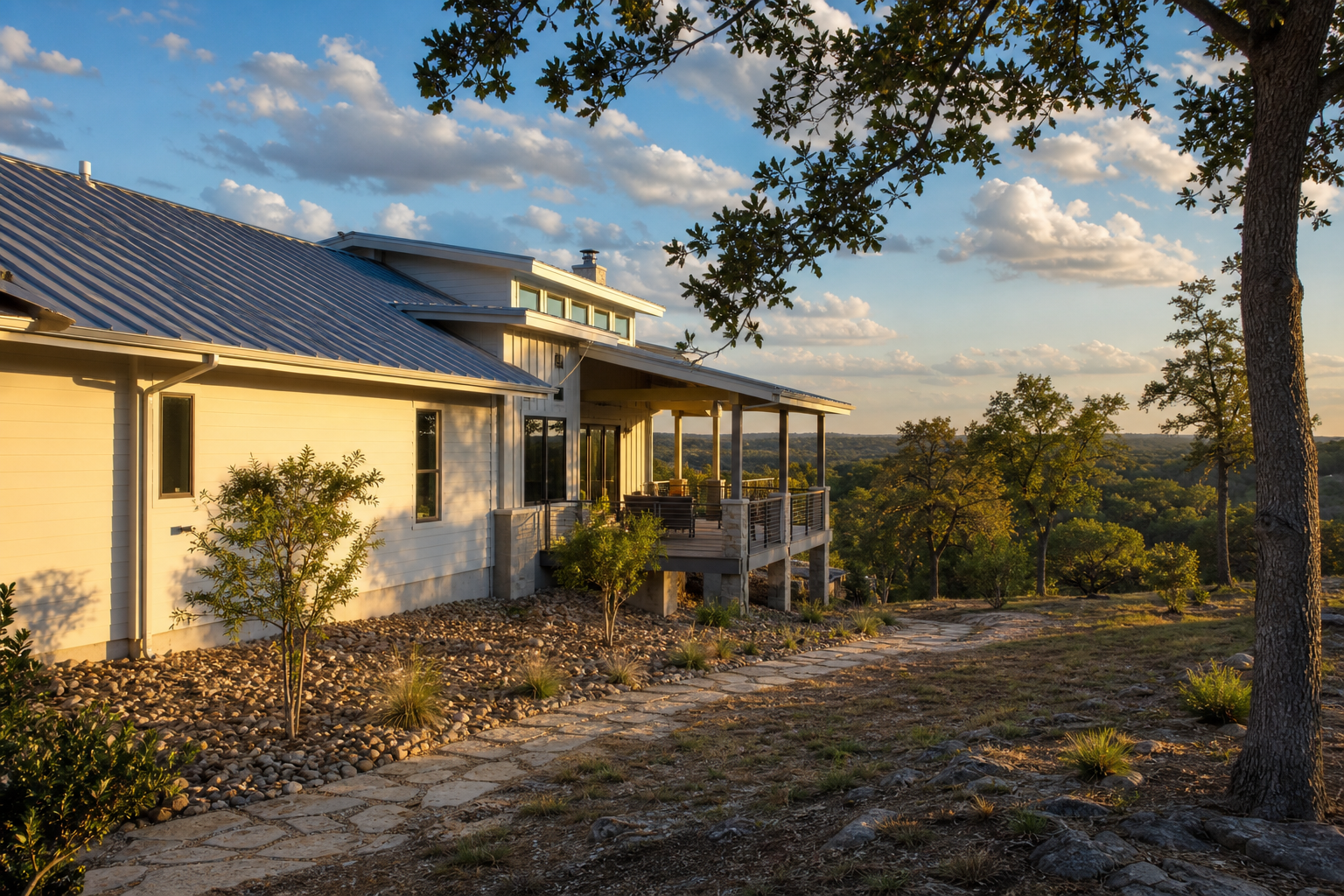
Standing-seam metal roofing: This is the most popular choice across rural Texas for good reason. Metal roofing is non-combustible, handles high winds common in this region, and lasts 40 to 60 years with minimal maintenance. For ranch properties in Parker County or lakefront builds near Possum Kingdom, metal is the workhorse option.
Clay or concrete tile: These offer excellent fire resistance and a more polished look suited to luxury properties in areas like Aledo or Weatherford. They are heavier, so your roof structure needs to be engineered accordingly.
Asphalt composition shingles with Class A ratings: More affordable than metal or tile, these are a solid middle ground. Make sure you verify the Class A designation specifically, as not all asphalt shingles carry it.
What to Avoid on Any Rural Texas Property
Wood shake and wood shingle roofs are the most dangerous choice in wildfire territory. They ignite rapidly from ember contact. If you are looking at an existing property in Jack County or western Parker County with a wood shake roof, factor the cost of a full roof replacement into your offer. I tell investors to treat this the same way you would treat a failed foundation inspection: it is a deal-breaker unless the price reflects the necessary fix.
Do Not Forget Vents and Soffits
Even a perfect metal roof can fail if embers enter through unprotected openings. Screen all roof vents, soffit vents, and eave openings with 1/8-inch metal mesh. This small detail prevents ember intrusion into your attic space, where one hot ember can ignite insulation and framing.
Creating Defensible Space Around Properties in Palo Pinto and Jack Counties
Defensible space is the managed area between your structure and the surrounding wildland. Think of it as your property’s firebreak. The Texas A&M Forest Service, which administers the Firewise USA program in Texas, provides detailed guidance on this, and I strongly recommend following it.
Zone 1: The Immediate Zone (0 to 5 Feet From Your Structure)
This is the most critical zone, especially for properties on acreage in Jack County or along the cedar-heavy draws near Possum Kingdom Lake. Within five feet of your home:
Use only non-combustible materials for decking, fencing, and ground cover (gravel, stone, or pavers)
Remove all dead vegetation, dried leaves, and mulch
Keep no firewood, propane tanks, or stored materials against the house
Trim tree branches so none overhang the roof or touch the structure
Zone 2: The Intermediate Zone (5 to 30 Feet)
This is where your landscaping choices matter most. Space trees so their canopies do not touch, keep grass mowed to four inches or less, and remove ladder fuels (low-growing vegetation that allows ground fire to climb into tree canopies). For ranch properties in Parker County where pasture meets the home site, maintaining this buffer is straightforward if you are already managing your grazing rotation.
Zone 3: The Extended Zone (30 to 100 Feet)
In this outer zone, you thin trees and brush to reduce overall fuel density. On a 20-acre tract in Palo Pinto County, you are not clearing everything. You are selectively removing the most flammable species, particularly cedar, and creating spacing that slows fire spread.
Fire-Resistant Landscaping for the Cross Timbers Region
What you plant matters as much as what you build. The Cross Timbers region that runs through Parker, Palo Pinto, and Jack counties is dominated by Ashe juniper (cedar), post oak, and native grasses. Cedar is one of the most explosive wildfire fuels in Texas because its oils are highly flammable and it retains dead material in its canopy. Here is how to make smart landscaping decisions.
Native Plants That Resist Fire
You do not have to sacrifice a beautiful landscape for fire safety. Several Texas-native and adapted species are naturally fire-resistant:
Live oak: Far more fire-resistant than post oak due to its higher moisture content in leaves
Texas mountain laurel: Evergreen, drought-tolerant, and slow to ignite
Red yucca: Low-growing, minimal fuel load, and thrives in the rocky soils common in Palo Pinto County
Buffalo grass and blue grama: Native grasses that stay low, require less water, and create less fuel volume than taller prairie grasses
Mexican buckeye: Deciduous, moderate moisture content, and well-suited to the Cross Timbers climate
What to Remove or Manage Aggressively
Ashe juniper (cedar): Remove within 30 feet of any structure without exception. Beyond that, thin aggressively.
Eastern red cedar: Same volatility as Ashe juniper; manage identically.
Dried ornamental grasses left uncut: These act as wicks during fire season. Cut them back every winter.
Having closed over 250 transactions in this market, including ranch and recreational land throughout these counties, I can tell you that buyers increasingly ask about wildfire preparedness. Properties that already have defensible space and fire-resistant landscaping in place command stronger offers and sell with fewer contingencies.
How Fire-Resistant Upgrades Affect Property Value and Insurance in Parker County
As an investor, you are thinking about return on investment. Fire-resistant upgrades deliver ROI through two channels: resale value and ongoing insurance costs.
Insurance Premium Impact
Insurance carriers serving rural Parker, Palo Pinto, and Jack County properties are paying close attention to wildfire risk. Properties with documented fire-resistant roofing, defensible space, and Firewise-compliant landscaping can qualify for lower premiums. Many rural properties in this corridor rely on private water wells rather than municipal fire hydrants, and fire suppression response times are longer in unincorporated areas. Insurance underwriters factor all of this in. Your fire-resistant upgrades directly address their risk calculations.
Resale and Rental Value
With the median listing price in Parker County at $557,175 as of June 2026 according to FRED data, and ranch properties in the county ranging well above that, protecting your investment from wildfire damage is not just about safety. It is about preserving and enhancing equity. Luxury properties in Parker County, particularly those on acreage west of Weatherford and along the Palo Pinto County line, benefit enormously from visible fire mitigation because buyers shopping in that price range are sophisticated enough to evaluate risk.
Exterior Construction Details That Matter in Wildfire Zones
Beyond roofing and landscaping, several exterior building details make or break your property’s fire resilience.
Fiber cement siding (such as HardiePlank) is non-combustible and outperforms vinyl or wood siding in fire exposure
Tempered or dual-pane windows resist radiant heat far better than single-pane glass, which can shatter from heat exposure and allow embers inside
Enclosed eaves and boxed soffits eliminate the gaps where embers accumulate
Metal or masonry fencing within five feet of the structure prevents fire from traveling along a wood fence line directly to your home
Non-combustible decking materials (composite or aluminum) protect the area where most families spend time outdoors
For first time home buyers in Weatherford considering properties that back up to undeveloped land, or for investors evaluating lake properties on Possum Kingdom Lake, these details should be part of your property inspection checklist before you make an offer.
Frequently Asked Questions
What is the most important fire-resistant upgrade for a rural Texas home?
A Class A fire-rated roof is the single most impactful upgrade. Metal roofing is the most popular choice in rural Parker, Palo Pinto, and Jack counties because it is non-combustible, wind-resistant, and lasts decades. Combined with 1/8-inch metal mesh screening on all vents and soffits, a metal roof dramatically reduces your risk of ember ignition.
How wide should defensible space be around a home in Palo Pinto County?
The Texas A&M Forest Service recommends maintaining defensible space in three zones: 0 to 5 feet with non-combustible materials only, 5 to 30 feet with managed and spaced vegetation, and 30 to 100 feet with thinned trees and reduced brush density. In the cedar-heavy terrain of Palo Pinto County, that 100-foot zone is especially important.
Is cedar (Ashe juniper) really that dangerous for wildfire?
Yes. Ashe juniper is one of the most flammable native species in Texas. Its oils ignite rapidly, and it retains dead material in its canopy that acts as fuel. Remove cedar within 30 feet of any structure and thin it aggressively beyond that distance across your property.
Do fire-resistant upgrades lower homeowners insurance in Parker County?
Many insurance carriers offer premium reductions for properties with documented fire-resistant roofing, defensible space, and Firewise-compliant landscaping. Since many rural Parker County properties rely on private water wells rather than municipal hydrants, these upgrades carry extra weight with underwriters.
What native Texas plants are fire-resistant for landscaping?
Live oak, Texas mountain laurel, red yucca, buffalo grass, blue grama, and Mexican buckeye are all native or adapted species that are naturally fire-resistant and thrive in the Cross Timbers climate of Parker, Palo Pinto, and Jack counties.
Should I choose metal roofing or asphalt shingles for a ranch property?
For ranch properties in Parker County and surrounding counties, metal roofing is generally the stronger choice. It is non-combustible, handles high winds, and requires minimal maintenance over a 40 to 60 year lifespan. Asphalt shingles with a Class A fire rating are a more affordable alternative if budget is a factor.
How does wildfire risk affect property values for ranch properties in Parker County?
Properties with visible fire mitigation, including fire-resistant roofing, defensible space, and managed landscaping, command stronger offers and sell with fewer contingencies. With the median listing price in Parker County at $557,175 as of June 2026, protecting that investment through fire-resistant upgrades is critical.
What exterior siding is best for wildfire zones?
Fiber cement siding is the recommended choice for homes in wildfire zones. It is non-combustible and significantly outperforms vinyl or wood siding when exposed to radiant heat or direct flame contact.
Are wood decks a fire hazard on rural Texas properties?
Yes. Wood decks within the immediate zone around your home can ignite from ember contact and carry fire directly to your structure. Use non-combustible decking materials such as composite or aluminum, especially within five feet of the home.
How do I find out if my property in Jack County is in a wildfire risk area?
The Texas A&M Forest Service provides wildfire risk assessment and administers the Firewise USA program statewide. They regularly issue burn bans for Jack, Palo Pinto, and Parker counties during dry periods. Contact them directly or work with a local real estate professional who understands the specific risks for your area.
The Bottom Line
Building or upgrading in the wildfire zones of Palo Pinto, Parker, and Jack counties is not about eliminating risk entirely. It is about making smart, documented decisions that protect your investment, reduce your insurance costs, and position your property competitively in a market where buyers are paying attention to fire resilience. Start with a Class A fire-rated metal roof, create defensible space in three clear zones, replace cedar with fire-resistant native plants, and upgrade your exterior materials.
I have spent 17 years helping buyers and investors find the right properties across this region, from luxury estates in Weatherford to recreational land in Jack County and lake properties on Possum Kingdom Lake. With 15 five-star reviews and over 250 closed transactions, I know this market and I know these properties. If you are building, upgrading, or evaluating a rural Texas property for wildfire readiness, I would love to walk through your options. Reach out to me, Lynae Amason, at 817-522-2897 or visit my office at 220 Fort Worth Hwy, Suite 700, in Weatherford.

Read More
REALTOR and Multiple Listing Service marksEqual Housing Opportunity
© 2026 Lynae Amason · Williams Trew Real Estate · TX License #0615086 · TREC Information About Brokerage Services · TREC Consumer Protection Notice · Powered by AgentSpotlight.ai