
Rebuilding After the Ross Fire: Soil and Vegetation Recovery in Palo Pinto and Jack Counties
Rebuilding After the Ross Fire: Soil and Vegetation Recovery in Palo Pinto and Jack Counties
What do landowners in Palo Pinto and Jack Counties need to know about soil and vegetation recovery after the Ross Fire before rebuilding or investing in burned land?
The Ross Fire burned over 90,400 acres across Palo Pinto and Jack Counties, and if you own land in the burn zone, your recovery timeline depends on soil health, erosion management, and strategic revegetation before any rebuilding begins.
Why This Matters Right Now in Palo Pinto and Jack Counties
The Ross Fire started near the city of Palo Pinto on August 24, 2026, and within hours it had grown to 15,000 acres as winds pushed flames north into Jack County. As of September 7, the Texas A&M Forest Service reports 157 structures destroyed, 140 structures damaged, and 453 structures saved. The fire is approximately 57% contained, but some debris continues to burn, and it could take weeks before fire-riddled trees across the terrain fully die out.
This is the second-largest wildfire in North Texas’ recorded history, according to the National Weather Service, behind only the 2011 Possum Kingdom Complex Fire that burned 126,734 acres. If you own ranch properties in this region, or you’re an investor evaluating land near Possum Kingdom Lake, the decisions you make in the next 6 to 12 months about soil recovery will determine the long-term value of your investment.
With 17 years of experience helping clients buy and sell ranch properties, farm land, and recreational land across Parker County, Palo Pinto, and Jack Counties, I can tell you that the questions I’m getting right now from landowners are urgent, and they deserve clear answers.
Understanding the Burn Zone: Where the Ross Fire Hit Hardest
You need to know exactly what happened on your property before you plan your next move. The Ross Fire burned in central Palo Pinto County, southeast of Possum Kingdom Lake, actively burning from US 180 near the city of Palo Pinto to TX 337 near Graford. The fire spread north into Jack County, forcing the evacuation of 630 households.
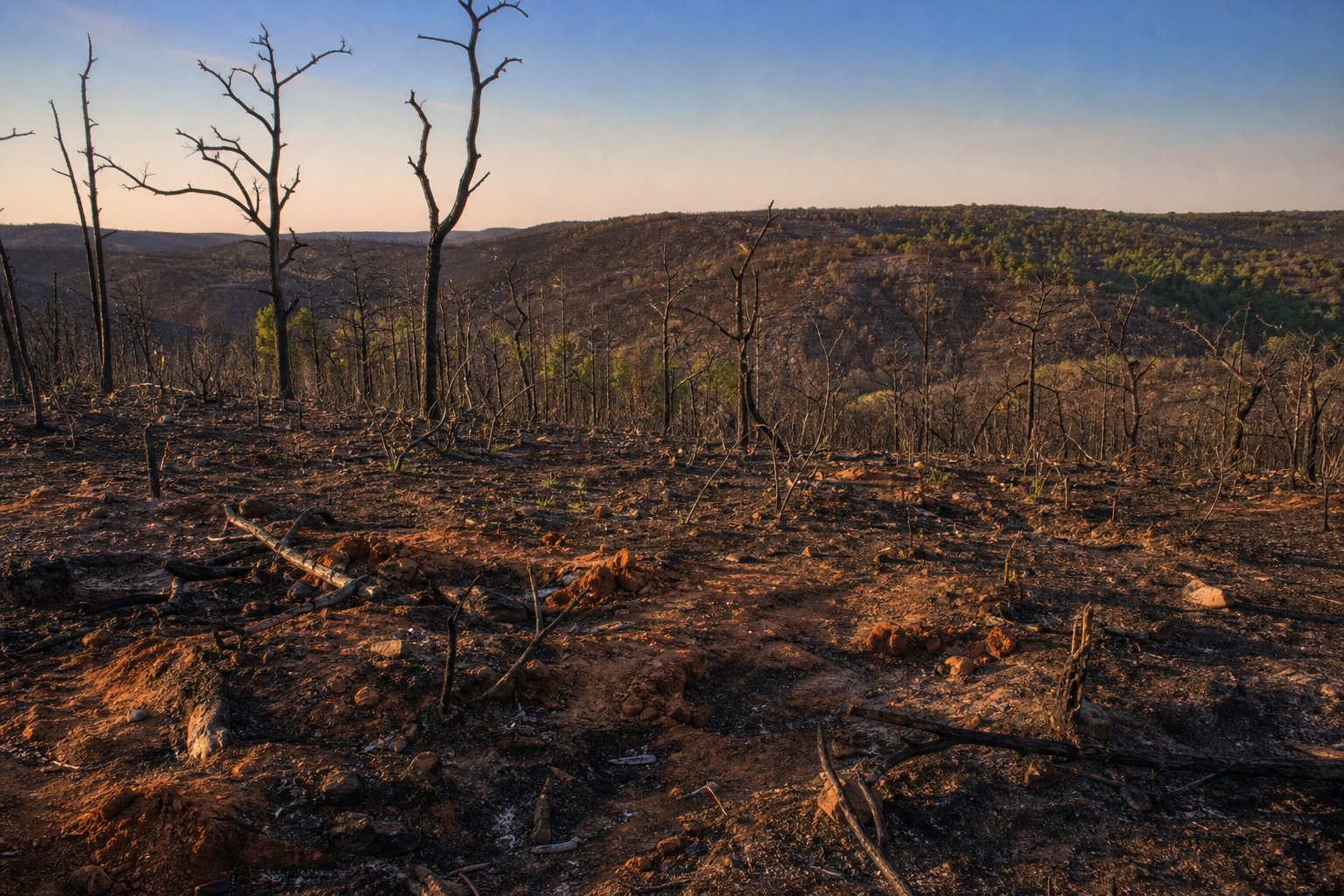
What makes this fire especially damaging to the land itself is the terrain. Firefighters reported extreme fire behavior, including trees torching in groups amid strong winds. Crews struggled to suppress flames in steep and rocky terrain, according to the Texas A&M Forest Service. That steep, rocky terrain is the same landscape that makes recovery harder, because burned slopes without vegetation are the most vulnerable to erosion.
What Caused These Conditions
The conditions that fed this fire were building for weeks. After more than a month without measurable rainfall, fine surface fuels became critically to extremely dry. Every high temperature in August measured above average, and there have been 30 days in 2026 with triple-digit temperatures or above. Burn bans were already in effect for Tarrant, Palo Pinto, and Jack Counties before the fire started.
A three-month forecast from NOAA shows North Texas has a maximum 40% chance of continued above-average temperatures through November, but the likelihood of rainfall should level out to average. So the question is: will the rain come in time to help your soil recover, or will drought compound the damage?
Soil Recovery After Wildfire: What Palo Pinto County Landowners Must Assess First
If you own burned land in Palo Pinto or Jack County, here is the sequence I recommend before you make any decisions about rebuilding, replanting, or selling.
Conduct a comprehensive soil test. You need to know your soil’s pH, organic matter content, and nutrient levels. High-severity fire can volatilize nitrogen and organic matter from topsoil, while phosphorus and potassium typically remain but can be redistributed by wind and water erosion.
Assess soil hydrophobicity. Intense wildfire creates a waxy, water-repellent layer in soil. In the Cross Timbers ecoregion, which encompasses both Palo Pinto and Jack Counties, this layer can persist for months to years depending on burn severity. If water beads on your soil surface rather than soaking in, you have a hydrophobicity problem.
Evaluate erosion risk immediately. The steep, rocky terrain in the Ross Fire burn zone is especially vulnerable. Without vegetation to hold soil, the first significant rainfall events can cause severe erosion, mudslides, and sediment runoff into waterways, including Possum Kingdom Lake.
Having closed over 250 transactions across this region, many of them on ranch and recreational land, I know that skipping the soil assessment phase is the most expensive mistake a landowner can make after a fire. What looks like minor surface damage can mask deep structural changes in the soil profile that affect everything from building foundations to pasture productivity.
Vegetation Recovery Timelines for the Cross Timbers Ecoregion
So how long will it actually take for your land to come back? Here is what the science tells us about the Cross Timbers ecoregion that covers Palo Pinto and Jack Counties.
Native grasses typically take 1 to 3 growing seasons to recover on their own, depending on rainfall and whether root systems survived
Brush and understory vegetation may begin regrowing within the first growing season, though full density takes longer
Mature tree canopy, the signature post oaks and blackjack oaks of the Cross Timbers, can take 5 to 15 years to approach pre-fire maturity
What does that mean for your property’s usability? If you’re running cattle, you may need to defer grazing for at least one to two full growing seasons to allow root systems to re-establish. If you’re planning construction, you need to address erosion control before breaking ground.
Protecting Your Land From Erosion Before Rebuilding
Erosion is your biggest enemy right now, not just because it strips topsoil, but because it can undermine any future building site, road, or fence line. The steep terrain where the Ross Fire burned means water will flow fast when rain finally arrives. What I tell my clients in situations like this is to prioritize erosion control measures before anything else.
Install temporary erosion barriers on slopes, particularly near drainages feeding into Possum Kingdom Lake
Apply mulch or straw cover to exposed soil areas where practical
Avoid heavy equipment on saturated burned soil, which compacts what little structure remains
Work with the USDA Natural Resources Conservation Service (NRCS) for site-specific guidance and potential cost-share programs
Investment Considerations for Burned Land in Palo Pinto and Jack Counties
If you’re a real estate investor evaluating fire-affected parcels, you’re facing both risk and opportunity. Let me be straightforward about both.
The risks are real. Burned ranchland will likely see temporary value depression. With 157 structures destroyed and 25 homes lost, some landowners will choose to sell rather than rebuild. Properties with unresolved soil issues, uncleared debris, or active erosion problems carry significant risk for any buyer.
The long-term fundamentals remain strong. Palo Pinto County sits approximately 60 miles west of Fort Worth. Lake properties on Possum Kingdom Lake have been a consistent draw for recreational buyers and investors for decades. Jack County offers large-acreage ranch properties that appeal to agricultural investors and those seeking recreational land.
What I would caution any investor to do before purchasing burned land is to verify whether the property carries wildfire insurance, understand how FEMA assistance may affect any transaction, and budget for soil remediation. FEMA approved a Fire Management Assistance Grant for the Ross Fire, making the state eligible for 75% reimbursement in suppression costs. Governor Abbott stated that Texas will provide all necessary resources to protect Texans from the fire. However, that federal assistance is directed at firefighting costs, not at individual land rehabilitation.
Rebuilding permits in both Palo Pinto County and Jack County may require updated soil assessments and erosion control plans. Plan for these costs before you close.
Livestock and Agricultural Recovery Near Possum Kingdom Lake
For those of you running cattle or managing agricultural operations in the burn zone, you already know the immediate impact was severe. The Graham Livestock Commission offered space for livestock displaced by the wildfire at the Old Mineral Wells Sale Barn. Residents of Palo Pinto and Jack Counties were directed to relocate livestock to facilities including the Parker County Sheriff’s Posse Arena Pens in Weatherford.
The community response has been remarkable, and it reflects something I’ve seen throughout my 17 years working in this part of Texas: people here take care of each other. But the question you’re asking now is: when can my land support livestock again?
The answer depends entirely on your soil recovery. Grazing too early on burned pasture destroys regrowth and extends your recovery timeline by years. Get a soil test, work with your local NRCS office, and plan for a conservative return to grazing.
Frequently Asked Questions
How long does soil take to recover after the Ross Fire in Palo Pinto County?
Soil recovery timelines vary by burn severity. In the Cross Timbers ecoregion covering Palo Pinto and Jack Counties, soil hydrophobicity can persist for months to years. Native grasses typically return within 1 to 3 growing seasons, while mature tree canopy may take 5 to 15 years. A soil test conducted after the fire cools is the first step in estimating your specific timeline.
What is soil hydrophobicity and why does it matter after the Ross Fire?
Intense wildfire creates a waxy, water-repellent layer in the soil. When rain hits hydrophobic soil, it runs off rather than soaking in, dramatically increasing erosion risk. This is especially dangerous in the steep, rocky terrain of the Ross Fire burn zone, where firefighters reported extreme fire behavior and trees torching in groups.
Can I rebuild on burned land in Jack County right away?
You should not rebuild until you’ve completed a comprehensive soil assessment and addressed erosion control. Rebuilding permits in Jack County may require updated soil assessments and erosion control plans. Skipping this step can lead to foundation problems and ongoing erosion issues that cost far more to fix later.
How does the Ross Fire affect property values in Palo Pinto County?
Burned ranchland will likely experience temporary value depression. However, the area’s proximity to Fort Worth (approximately 60 miles) and the enduring appeal of lake properties on Possum Kingdom Lake support long-term value recovery. Investors should factor in soil remediation costs when evaluating fire-affected parcels.
What federal assistance is available for Ross Fire landowners?
FEMA approved a Fire Management Assistance Grant for the Ross Fire, making the state eligible for 75% reimbursement in suppression costs. This assistance is directed at firefighting operations, not individual property rehabilitation. Landowners should contact the NRCS for potential cost-share programs related to soil and vegetation recovery.
When can I return cattle to burned pasture in Palo Pinto or Jack County?
Grazing too early on burned pasture destroys new root growth and extends recovery timelines significantly. Most fire science guidance recommends deferring grazing for at least one to two full growing seasons. Get a soil test and work with your local NRCS office for a site-specific recommendation.
Is there erosion risk near Possum Kingdom Lake after the Ross Fire?
Yes, significant erosion risk exists. Without vegetation to hold soil on burned slopes, the first heavy rainfall events can cause sediment runoff directly into Possum Kingdom Lake and its tributaries. Temporary erosion barriers and mulch cover on exposed slopes are critical mitigation steps.
How many structures did the Ross Fire destroy?
According to the Texas A&M Forest Service, as of September 7, 2026, 157 structures have been destroyed, 140 structures are damaged, and 453 structures have been saved. Among the destroyed structures, 25 were confirmed homes.
Should I sell my burned land in Jack County or rebuild?
That depends on your financial position, your recovery timeline tolerance, and whether you carry wildfire insurance. If you’re an investor considering purchasing burned land, factor in soil remediation costs, erosion control, and the 1 to 3 year vegetation recovery window. If you’re a landowner, a soil assessment will tell you what you’re actually working with.
How does the Ross Fire compare to the 2011 Possum Kingdom Complex Fire?
The Ross Fire has burned over 90,400 acres, making it the second-largest wildfire in North Texas’ recorded history according to the National Weather Service. The 2011 Possum Kingdom Complex Fire burned 126,734 acres. Both fires occurred in the same Cross Timbers ecoregion, and recovery lessons from 2011 are directly applicable to 2026.
The Bottom Line
If you own land in Palo Pinto or Jack County that was affected by the Ross Fire, your first step is not rebuilding. It is understanding what happened to your soil. Every decision that follows, from erosion control to livestock management to construction planning, depends on that foundation. Investors evaluating fire-affected parcels should approach this market with clear eyes: the long-term fundamentals of this region are strong, but the short-term costs of proper recovery are real.
With 250 closed transactions, 15 five-star client reviews, and nearly two decades helping clients navigate ranch properties, farm land, and recreational land across Parker County, Palo Pinto, and the surrounding counties, I’m here to help you evaluate your options. Whether you’re a landowner deciding whether to rebuild or an investor looking at fire-affected parcels near Possum Kingdom Lake, I can help you understand what the land is actually worth and what recovery looks like. Call me at 817-522-2897 or reach out through my office at 220 Fort Worth Hwy, Suite 700, Weatherford, TX 76086. I’m Lynae Amason, and this is my community. Let’s figure out your next step together.