
Creating Defensible Space for Weatherford Countryside Properties: Your Wildfire Readiness Guide
Is your countryside home in Weatherford and the surrounding North Texas counties prepared to survive a wildfire, and what does creating defensible space actually involve?
Yes, and it starts now. Defensible space is the managed buffer zone between your structure and surrounding wildland vegetation, and for countryside properties across Parker County and neighboring counties, it is no longer optional. It is the single most important factor in whether your property survives a fire event.
Why Wildfire Preparedness Matters in Weatherford and Parker County Right Now
If you own ranch properties in Parker County, land along the Palo Pinto County line, or a countryside home anywhere between Weatherford and Jack County, this is the most urgent conversation you can have about protecting your investment. The Ross Fire, which sparked near Palo Pinto on August 24, 2026, has burned at least 90,400 acres across Palo Pinto and Jack counties, destroying 157 structures and damaging 140 more. It is now the second-largest wildfire in North Texas history.
Here is what also demands your attention: 453 structures were saved during the Ross Fire. That is nearly three times the number destroyed. The difference, in case after case, was defensible space.
I have spent 17 years helping clients buy, sell, and protect properties across Parker County, from ranches along FM 1189 to luxury homes near the historic Weatherford square. I live on a ranch with my husband, raise cattle, and participate in the equestrian community here. The land in this region is not abstract to me; it is personal. And after watching the Ross Fire unfold just one county to our west, I can tell you that every property owner in our area needs to take wildfire preparedness seriously in 2026 and beyond.
Understanding the Three Zones of Defensible Space for North Texas Properties
The Texas A&M Forest Service and the Texas Wildfire Risk Assessment Portal break defensible space into three distinct zones. If you own countryside acreage anywhere from Weatherford to Possum Kingdom Lake, here is exactly what each zone requires.
Zone 1: The Immediate Zone (0 to 5 Feet from Your Structure)
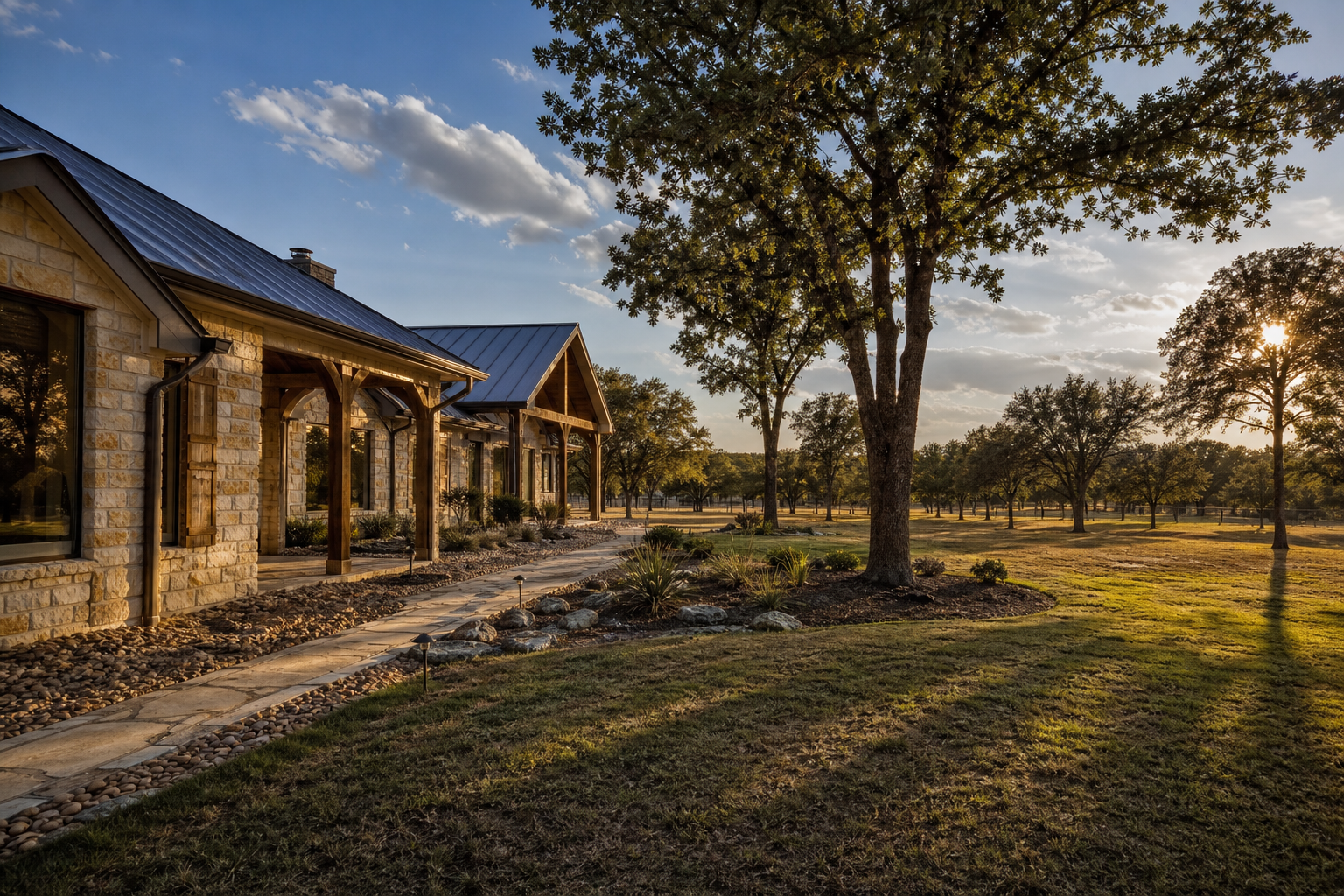
This is the most critical zone. According to the Texas Department of Insurance, you should keep all fire-prone landscaping, plants, and decking at least 5 feet from the building. Consider replacing combustible material with rock gardens, concrete walkways, non-combustible decking, or stone patios. Remove vegetation from roofs and gutters and trim any tree branches hanging over the roof or chimney.
The Texas Wildfire Risk Assessment Portal notes that cleaning out combustible material from just the first five feet around the house has been shown multiple times to increase the likelihood of a structure surviving a wildfire. Five feet. That is all it takes to start making a measurable difference.
Zone 2: The Intermediate Zone (5 to 30 Feet)
In this zone, you need to create space between trees and tree crowns. Break up the continuity of fuel across the landscape by limiting vegetation to small clusters and creating fuel breaks with flower beds, driveways, or walkways. For investors with ranch properties in Parker County running cattle or horses, this zone often includes fence lines, feed storage, and outbuildings that need deliberate clearance.
Zone 3: The Extended Zone (30 to 100+ Feet)
This is where you interrupt the fire’s path and keep flames small and on the ground. Clear vegetation from outbuildings, propane tanks, and other infrastructure. Remove heavy accumulations of litter and debris, dead or decaying plant material, and smaller conifers growing between mature trees. Reduce the density of taller trees throughout the zone.
For properties with significant acreage, and many ranch properties in Parker County sit on 10 to 50 or more acres, Zone 3 management is an ongoing commitment, not a weekend project.
How Wildfire Risk Impacts Property Values and Insurance in Parker County
If you are evaluating investment properties in this market, wildfire preparedness is now a financial calculation, not just a safety one. More than 8 million Texans, about 32% of the state’s population, live in a wildland-urban interface according to the Texas Department of Insurance. Yet only about 20% of businesses in those areas have a wildfire protection plan.
What does that mean for your bottom line? Properties with documented wildfire mitigation measures are increasingly attractive to both buyers and insurers. Meanwhile, properties without defensible space may face rising insurance premiums or even non-renewal. Tarrant County has issued a 90-day burn ban as wildfire threats continue across the region, and Dallas County has been under a similar ban since July 27.
With Parker County’s median sales price at $475,000 in Q2 2026 and the median listing price reaching $557,175 as of June 2026 according to Federal Reserve Bank of St. Louis data, you are protecting a substantial asset. The All-Transactions House Price Index for Parker County reached 304.52 (with the year 2000 as the baseline of 100), meaning home values here have more than tripled since 2000. That kind of long-term appreciation is worth defending with $500 in gravel and a weekend of brush clearing.
Having closed over 250 transactions across this region and holding an ABR designation, I help investors evaluate properties through every lens, including wildfire resilience. It is part of the due diligence conversation I have with every buyer looking at countryside acreage.
The Ross Fire: What Weatherford and Parker County Investors Need to Learn
In 2026, the Texas A&M Forest Service has responded to 1,078 wildfires burning 301,528 acres. In August alone, the agency responded to 313 wildfires for 121,774 acres. For comparison, all of 2025 saw 6,304 wildfires burning about 132,366 acres total. The 2026 season has already more than doubled last year’s burned acreage.
Texas A&M Forest Service fire analyst Walter Flocke stated that the rapid onset of a flash drought increased fire occurrence and intensity statewide in August, and that critically dry fuels are present across much of North, Central, and East Texas.
Nine in 10 wildfires are caused by people, according to the Texas A&M Forest Service. Common causes include burning debris on windy days, dragging tow chains on the ground, or driving on tall grass. Equipment use, including vehicles, trailers, and ATVs, is the second-most common cause behind debris burning.
So what does this mean for you as a property owner in Weatherford or the surrounding countryside? It means the threat is not hypothetical. It is geographic and seasonal reality. If you own lake properties near Possum Kingdom Lake or ranch acreage in Palo Pinto or Jack County, you are quite literally bordering the Ross Fire’s footprint.
Emergency Access and Rural Property Design in Parker County
Here is something many investors overlook when acquiring countryside properties: can a fire truck actually reach your structures? The Texas Wildfire Risk Assessment Portal specifies that public and private streets should be a minimum of 10 feet wide to allow two traffic lanes. Curves and intersections need to be wide enough for large fire equipment to pass and turn. Streets and bridges should withstand at least 40,000 pounds, and dead-end streets or long driveways should include a turnaround area designed as a T or circle large enough for emergency vehicles.
If you are looking at ranch properties in Parker County or recreational land in the surrounding counties, evaluate access roads as part of your purchase decision. A beautiful 40-acre tract with a single narrow cattle path for access is a liability during a fire event, no matter how much defensible space you have created around the structures themselves.
Firewise Landscaping for Weatherford and North Texas Countryside Homes
Firewise landscaping is a set of design and maintenance practices specifically aimed at reducing the chance that flames reach or damage a home. It focuses on creating defensible space, selecting fire-resistant plants, and managing vegetation in ways that slow fire spread.
What I tell the investors I work with is that Firewise landscaping is not a one-time project. It requires ongoing care. Throughout the year, you need to monitor vegetation growth and adjust landscaping as conditions change. For properties in this part of Texas, that means paying particular attention during late summer drought conditions, which is exactly when the Ross Fire ignited.
With Weatherford’s population having grown approximately 25% over five years to 38,000, and 229 new homes listed in the last 30 days alone (up 20.5% year over year), more structures are pushing into that wildland-urban interface every season. Rated 5 out of 5 stars by 15 past clients, I take seriously the responsibility of guiding buyers toward properties that are both beautiful and resilient.
Frequently Asked Questions
What is defensible space, and why do Weatherford countryside properties need it?
Defensible space is the managed buffer between your home and surrounding wildland vegetation. According to the Texas Wildfire Risk Assessment Portal, this space, when maintained properly, slows or stops the spread of wildfire and protects your home from catching fire. It is also important for protecting firefighters defending your property. With the Ross Fire burning 90,400 acres just one county west of Parker County, defensible space is essential for countryside homes here.
How far should defensible space extend around a property in Parker County?
The three recognized zones extend from 0 to 5 feet (immediate zone), 5 to 30 feet (intermediate zone), and 30 to 100 feet or more (extended zone) from the furthest exterior point of the home. The Texas Department of Insurance and Texas A&M Forest Service both recommend maintaining all three zones for countryside properties in North Texas.
What should I remove from Zone 1, the area closest to my home?
Keep all fire-prone landscaping, plants, and combustible decking at least 5 feet away from your structure. Replace them with rock gardens, concrete walkways, non-combustible decking, stone patios, or irrigated grass. Remove vegetation from roofs and gutters and trim any branches hanging over the roof or chimney.
How does wildfire risk affect insurance on ranch properties in Parker County?
Properties in the wildland-urban interface face rising premiums or potential non-renewal. The Texas Department of Insurance notes that only about 20% of businesses in wildfire-prone areas have a protection plan. Documented defensible space and Firewise landscaping can help demonstrate risk mitigation to insurers.
What caused the Ross Fire near Palo Pinto County in 2026?
The Ross Fire began near U.S. Highway 180 and R D Bell Road, approximately 3 miles southwest of Palo Pinto, on August 24, 2026. While the specific ignition source is under investigation, the Texas A&M Forest Service reports that nine in 10 wildfires are caused by people, with debris burning and equipment use as the two leading causes.
How large is the Ross Fire, and how close is it to Weatherford?
The Ross Fire has burned at least 90,400 acres across Palo Pinto and Jack counties and is approximately 57% contained. Palo Pinto County directly borders Parker County to the west, placing Weatherford-area properties within a realistic radius of concern during high-wind events.
Are burn bans currently in effect near Parker County?
Yes. Tarrant County has issued a 90-day burn ban as wildfire threats continue, and Dallas County has been under a 90-day burn ban since July 27. Check with Parker County and your specific county for the most current local restrictions before any outdoor burning.
What are the driveway and access requirements for fire truck access to rural properties?
Roads should be at least 10 feet wide for two traffic lanes. Curves and intersections must accommodate large fire equipment. Roads and bridges should support at least 40,000 pounds. Dead-end streets and long driveways need a T or circle turnaround large enough for emergency vehicles to turn around.
Is Firewise landscaping a one-time project for countryside properties?
No. Firewise landscaping requires ongoing care throughout the year. You should monitor vegetation growth and adjust landscaping as conditions change, paying particular attention during drought conditions and late summer, which is when North Texas wildfire risk peaks.
How many structures were saved during the Ross Fire thanks to defensible space?
According to Texas A&M Forest Service data, 453 structures were saved during the Ross Fire, compared to 157 destroyed and 140 damaged. Reports from similar Texas fires, like the Rolling Pines Fire, confirmed that structures classified as defensible were the ones firefighters could actually stay and protect.
The Bottom Line
Defensible space is not a luxury feature for countryside properties in Weatherford and the surrounding North Texas counties. It is a financial imperative. With the Ross Fire still burning in Palo Pinto and Jack counties and 2026 wildfire acreage already more than doubling the entire 2025 season, every property owner and investor in this region needs to evaluate their structures, their landscaping, and their access roads.
Whether you are buying a home in Weatherford, looking at homes for sale in the area, or evaluating first-time home buying options, wildfire preparedness should be part of your acquisition checklist and ongoing property management plan. I would love to help you find the right property and protect it the right way. Give me a call at 817-522-2897 or visit my office at 220 Fort Worth Hwy, Suite 700 in Weatherford. After 17 years in this market and 250 closed transactions, I know this land, and I know what it takes to invest wisely here.